
Most of the first-time heirs we meet have been asked to sign something within weeks of the funeral, such as a trustee acceptance, an account transfer form, or a listing agreement for the house. Very few of those signatures need to happen that fast. The choices you make in those early months about taxes, trusts, and which advisors to keep are usually the hardest ones to reverse.
A multi-family office helps a first-time heir by putting one coordinated team in charge of the estate, the trusts, the taxes, and the investments. That team organizes what you've received and works directly with your attorney and CPA. Before you sell, move, or reinvest anything, it shows you how the pieces connect.
At Legacy Bridge Private Family Offices, we work with many heirs who never expected to manage family wealth this soon. Some inherited from a parent. Others inherited from a spouse, or found out about a trust when the attorney read the will. Nearly every one of them needed structure before speed, which is why many first-time heirs start by looking at multi family office services before they move a single dollar.
TL;DR Quick Answers
Multi Family Office Services
Multi-family office services give affluent families one shared advisory team for investments, taxes, estate and trust coordination, family governance, philanthropy, and reporting. A multi-family office starts with the family's full balance sheet rather than the investment account, and it coordinates the family's existing attorney and CPA so the family doesn't have to carry messages between them.
Investment oversight: asset allocation, manager selection, liquidity planning, and a written investment policy
Personal CFO: cash flow, bill pay, debt, and tax timing handled by someone who sees the whole picture
Tax coordination: year-round planning with your CPA, beyond filing season
Estate and trust coordination: working with your attorney and trustee on documents, trust funding, and distributions
Family governance and education: family meetings, decision rules, and preparing heirs to act as stewards
Philanthropy: donor-advised funds, foundations, and family giving plans tied to the tax plan
Consolidated reporting: every account, trust, and entity in one view
Who it fits: Families managing roughly $10 million or more, or wealth spread across trusts, entities, real estate, or a family business. For first-time heirs, the first 90 days usually focus on documents, tax reserves, and one consolidated balance sheet before any major move.
Legacy Bridge works alongside your existing professionals, and legal and tax advice stays with your licensed attorney and CPA.
Top Takeaways
Slow down first. Most inheritance decisions can wait, and the first 90 days are better spent on documents, tax reserves, and one consolidated balance sheet.
Find out whether you inherited outright or through a trust, since that decides who controls the assets and how distributions work.
A multi-family office coordinates your attorney, CPA, and trustee so you don't end up carrying messages between them.
Get your parents' advisors working from one plan before deciding whether to replace anyone.
Treat your own education as part of the plan. Heirs who understand their balance sheet make steadier decisions for decades.
What Does a Multi-Family Office Do for a First-Time Heir?
A multi-family office is an independent advisory firm that manages the financial lives of several wealthy families through one shared team. Unlike a single-family office, it doesn't build a private staff for one household. And where most financial advisors start with the investment account, a multi-family office starts with the full balance sheet, including trusts, entities, tax exposure, estate documents, insurance, and the people involved.
That wider view matters most to someone new to wealth. Heirs tend to receive structures long before anyone explains them. It might be a trust, an LLC that holds the lake house, a minority stake in the family company, or a brokerage account with a cost basis older than the heir. We turn that stack into something you can read and question.
The First 90 Days After an Inheritance
Very little about an inheritance is truly urgent, even when it feels that way. The pressure usually comes from well-meaning relatives, a banker, or your own nerves. We tell new heirs to treat the first 90 days as a period for getting clear. Most decisions can wait.
During that window, a multi-family office typically helps you:
Put off moves you can't reverse, like selling the family home or paying off every loan at once
Collect the will, trust agreements, account statements, recent tax returns, insurance policies, and entity records
Build one consolidated balance sheet showing what you own, what you owe, and what's still tied up in the estate
Hold back enough cash for estate, income, and property taxes
Assign every open item to a named person, so nothing slips between your advisors
By the end of the third month, you should know what you have and what's still pending. You should also know which decisions actually belong to you.
Estate Settlement, Trusts, and Your Role as a Beneficiary
Many heirs are surprised to learn the money isn't theirs yet. If your parents left assets to you outright, they pass to you once the estate settles. If your parent left assets in trust, the trust owns them, and a trustee manages and distributes them under its terms.
Which situation you're in shapes nearly every next step. A multi-family office reads the trust with you in plain English, explains what the trustee can and can't do, and tracks distributions and tax reporting. We work alongside the trustee and the estate attorney rather than in place of them.
Two tax issues usually come up early. Inherited assets often receive a step-up in cost basis, which can sharply reduce the capital gains you'd owe on a sale. For 2026, the federal estate and gift tax exemption is $15 million per person, and the One Big Beautiful Bill Act made that level permanent with annual inflation adjustments. How either rule applies to you depends on the facts, so confirm the details with your CPA and attorney.
Multi Family Office Services That Matter Most for New Heirs
Some services matter more than others in year one. First-time heirs tend to lean on these:
Consolidated reporting: every account, trust, and entity in one view, instead of statements from six institutions
Personal CFO support: cash flow, bill pay, liquidity, and tax timing handled by someone who sees the whole picture
Tax coordination: estimated payments, basis records, and trust taxes planned with your CPA during the year, not just in April
A written investment policy: how the money should be invested, including a gradual plan for any concentrated inherited stock
Trust coordination: steady communication between you, the trustee, and the attorney
Family governance: ground rules for shared assets and joint decisions, which matter most when siblings inherit together
Philanthropy: a way to continue a parent's giving, or begin your own, with the tax plan in view
Your own financial education: enough fluency to ask sharp questions and judge the advice you get
Keeping, Replacing, or Aligning Your Parents' Advisors
Plenty of heirs want a clean slate, and sometimes that's the right call. Often, though, the family's attorney and CPA carry years of context. They know why your parents set up the trusts, what your parents gave away during their lives, and which tax elections they made. When those advisors leave, that history leaves with them.
Before deciding who to replace, find out who is coordinating all of these people. You shouldn't have to serve as the messenger between specialists. With family office services, you gain a dedicated team that brings the advisors you trust together under one coordinated plan, simplifies complex financial decisions, and gives you time to decide with full information whether anyone should go.
Education, Stewardship, and the Next Generation
An inheritance often turns you into the person planning for the next generation, sometimes before you've absorbed what you received. For many families, school is where that shows up first. The families we work with often set aside money for private school or college, make annual gifts to grandchildren, or create trusts that pay tuition directly.
Preparation runs the other way too. Heirs who sit in on family meetings, attend an advisor review, or help choose a charitable gift build judgment years before the stakes get high. The same coordination that helps owners plan a family office-led business succession helps a new heir become a steward of the family's wealth and not only its beneficiary.
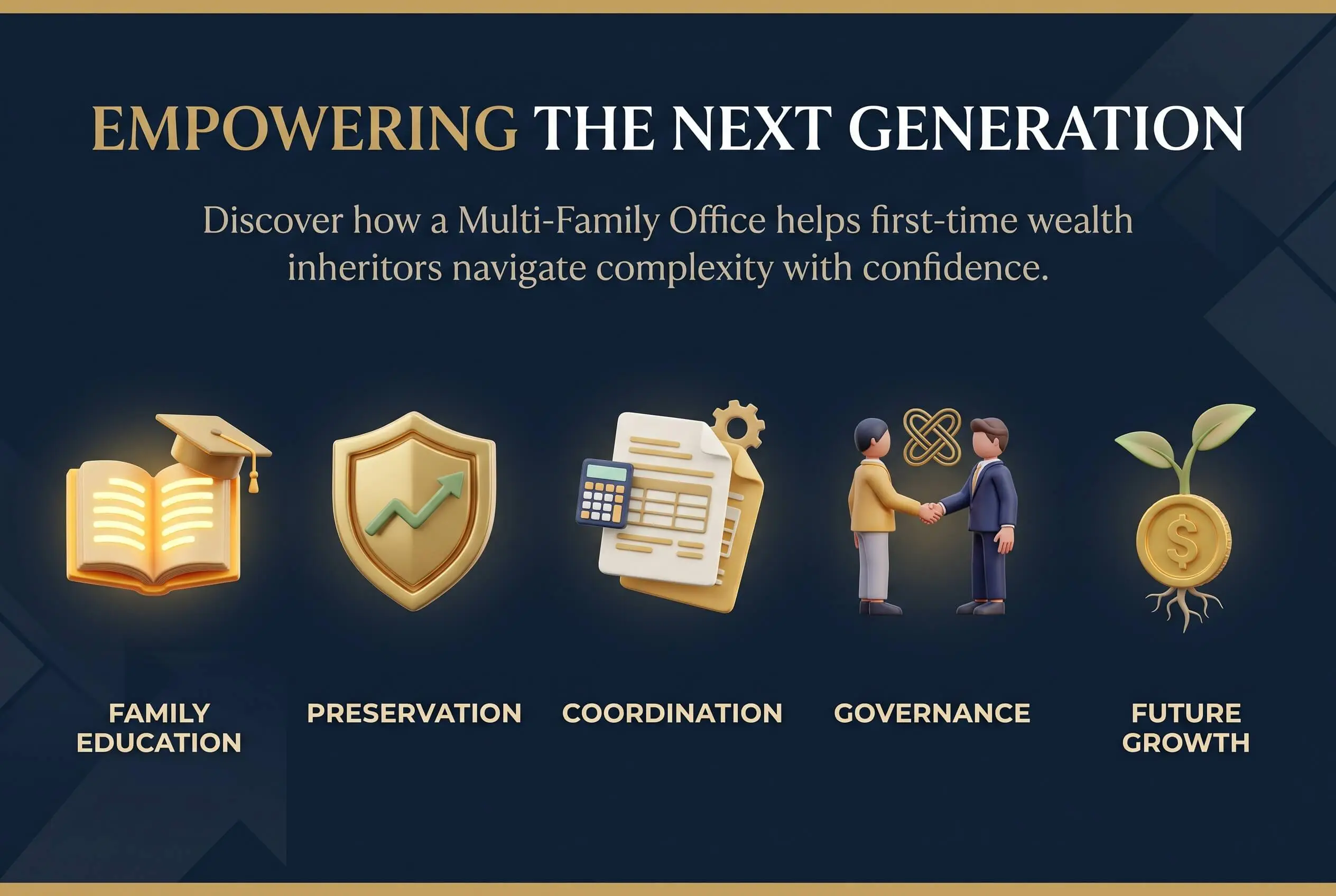
"When a new heir first sits down with us, the conversation rarely begins with investments. Usually they bring a folder. Inside there's a trust they haven't read, statements from four institutions, and a tax bill nobody mentioned. The families who come through this well don't rush to put the money to work. They spend a few months learning what they own and why the family set it up that way. Once an heir can walk us through their own balance sheet, the big decisions get easier, and they stop feeling like a guest in their family's plan."
7 Essential Resources
When a new heir asks what to read first, we send them to them. None of them replaces advice on your own situation, but between them they answer most of what comes up in a first meeting.
1. Understand the Scale of the Great Wealth Transfer
Cerulli Associates estimates how much wealth will pass to heirs, spouses, and charities through 2048. Look closely at the spousal figures, because a large share of inheritances go to a surviving spouse before they ever reach the children.
Source: Cerulli Associates, Cerulli Anticipates $124 Trillion in Wealth Will Transfer Through 2048
2. Check the 2026 Estate and Gift Tax Exemption
This short Morgan Lewis update covers the 2026 federal exemption of $15 million per person and the $19,000 annual gift exclusion. Read to the end, where the authors point out that 12 states and the District of Columbia still levy their own estate taxes.
Source: Morgan Lewis, IRS Announces Increased Gift and Estate Tax Exemption Amounts for 2026
3. Vet Any Advisory Firm Before You Sign
The SEC's lookup tool shows a firm's registration, Form ADV, and disciplinary history. We'd run the check on your parents' advisor too, along with any new firm you interview.
Source: SEC, Investment Adviser Public Disclosure
4. Compare Family Office Models
Morgan Lewis weighs single-family, multi-family, hybrid, and outsourced models on cost, control, and confidentiality. Its argument that complexity matters more than asset size fits heirs who inherit trusts, entities, or part of a business.
Source: Morgan Lewis, Control, Cost, and Complexity: Finding the Right Family Office Model
5. Learn From Women Who Have Already Inherited
UBS surveyed 2,000 women investors with at least $1 million about inheriting from parents and spouses. Their advice applies to any first-time heir, especially learning the size and structure of an inheritance ahead of time and planning for taxes early.
6. Gauge How Prepared Heirs Really Feel
Kiplinger pulls together New York Life and LegalShield findings on how many expected heirs doubt they can manage what they'll receive. It's a quick read and an easy one to forward to a sibling.
Source: Kiplinger, Are Your Heirs Prepared?
7. Explore Giving Vehicles Before You Give
The IRS explains how donor-advised funds work, who controls the money once you give it, and where the agency has seen abuse. Read it before you continue a parent's giving or set up your own.
Source: IRS, Donor-Advised Funds
After all seven, our view is that heirs have plenty of information and too little coordination. Someone has to be accountable for turning tax rules, trust terms, and family intentions into a plan the heir actually understands.
Supporting Statistics
The surveys point the same way. More people are inheriting, and many of them don't feel ready.
1. Trillions are already moving to heirs
Cerulli Associates projects that $124 trillion will transfer through 2048. Cerulli expects $105 trillion of that total to reach heirs and $18 trillion to go to charity, while $54 trillion passes first to spouses before moving down a generation.
What it means: Surviving spouses and adult children are becoming one of the largest groups of first-time decision-makers in American wealth.
What we see: Heirs often receive trusts and family entities years before anyone explains how they work.
Source: Cerulli Associates, Cerulli Anticipates $124 Trillion in Wealth Will Transfer Through 2048
2. Heirs often leave the family's advisor
In a 2025 Harris Poll, 43% of heirs of high-net-worth Americans aged 55 and older said they plan to switch financial advisors after inheriting, even if they generally like that advisor. Cerulli's own research found that 52% of affluent investors expecting or receiving an inheritance don't plan to keep their benefactor's advisor.
What it means: Around half of heirs will change part of their advisory team close to the time they inherit.
What we see: When an heir switches before understanding the plan, they lose years of context about trusts, gifts, and tax elections.
3. Many heirs inherit without a plan or a conversation
UBS found that nearly one-third of women who inherited from parents had no prior conversation about it, and four in 10 inherited with no wealth transfer or estate plan in place. Eighty percent of those women ran into challenges along the way, and more than half hit a financial surprise, often the size of the tax bill.
What it means: For a lot of heirs, the first job is tracking down documents, accounts, and obligations nobody listed for them.
What we see: A consolidated balance sheet built early heads off most of the surprises that push people into rushed decisions.
Final Thoughts
If we could give a first-time heir one piece of advice, it would be to understand before acting. The money will still be there in three months. A rushed sale, a skipped tax reserve, or an advisor let go for the wrong reason is much harder to undo.
We'll also say plainly that a multi-family office isn't for everyone. A modest or simple inheritance may only need a good CPA, an estate attorney, and a fee-only planner. Once trusts, a business interest, real estate, or siblings sharing assets enter the picture, coordination becomes most of the work.
What the data shows:
Trillions of dollars are moving to heirs and spouses, and many of them have never managed wealth at this scale.
A large share of heirs inherit without a prior conversation, a plan, or a warning about taxes.
What we've seen at Legacy Bridge:
Most of the costly mistakes we see trace back to an heir who never saw the full picture, rather than to poor judgment.
The most confident heirs learned how their trusts and accounts work before making any big decision.
Getting trusted advisors onto one plan usually works better than starting over with new ones.
Siblings who talk early about shared assets avoid a lot of friction when a property or business stake comes up for sale.
Inheriting wealth for the first time can feel like being handed the keys to a house you've never been inside. A good multi-family office walks through each room with you through its multi-family office wealth management services before asking what you'd like to change.
Frequently Asked Questions
How can a multi-family office help first-time wealth inheritors?
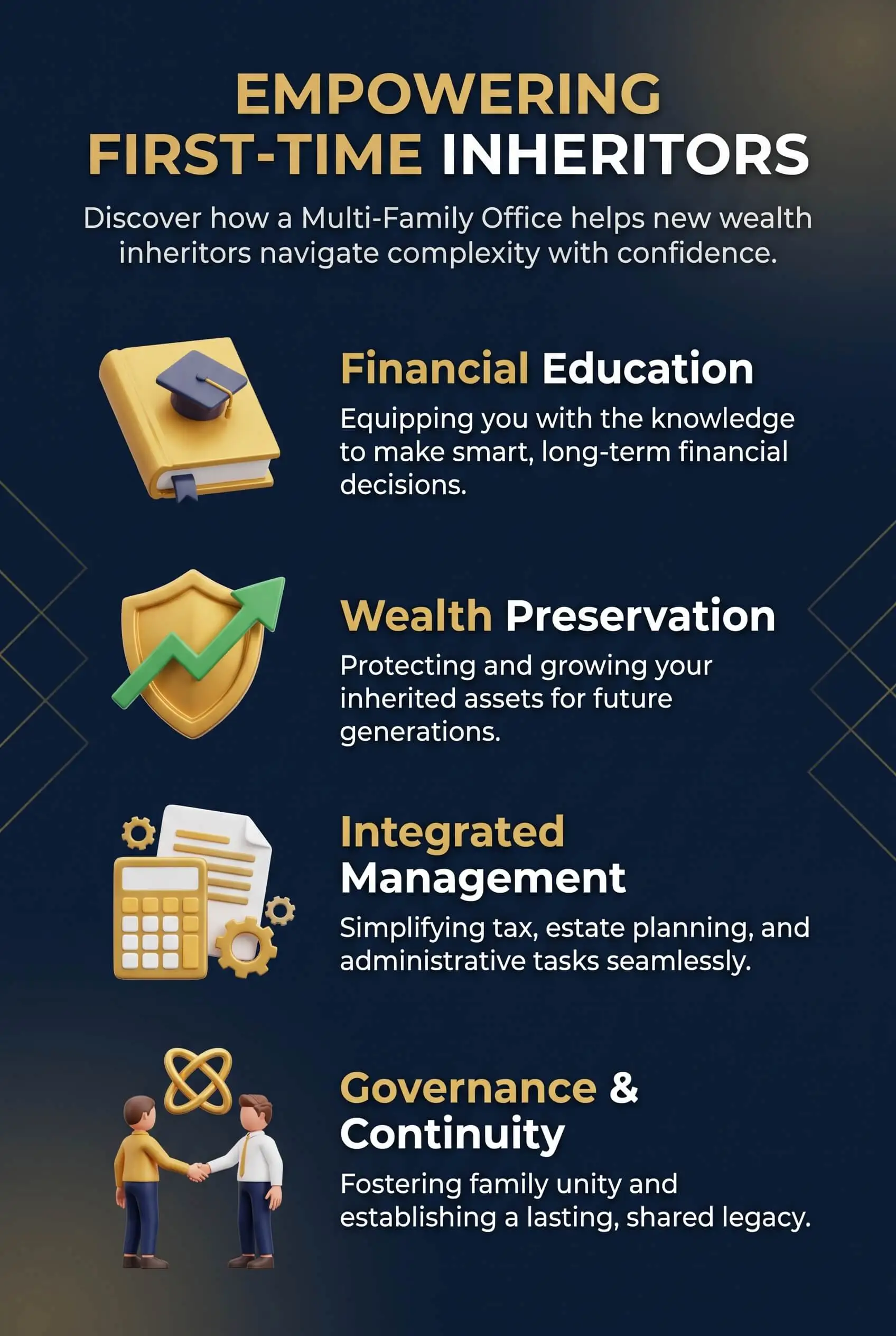
A multi-family office gives a first-time heir one coordinated team for the estate, trusts, taxes, and investments. It builds a consolidated balance sheet, works with your attorney and CPA, and explains how each piece fits. That gives you time to understand your inheritance before you change anything.
What should I do first after inheriting a large amount of money?
Hold off on major decisions and gather the will, trust agreements, account statements, tax returns, and insurance policies. Set aside cash for estate and income taxes, then build one picture of what you own and owe. Selling property or reinvesting everything can usually wait a few months.
What multi family office services do new heirs usually need?
New heirs rely most on consolidated reporting, Personal CFO support for cash flow and bills, tax coordination with their CPA, a written investment policy, and trust coordination. Family governance and financial education grow more important when siblings inherit shared assets or a stake in a family business together.
Should I keep my parents' financial advisor after I inherit?
You don't have to, but it's worth waiting before you leave. Your parents' advisors often know why your parents built the trusts and which tax elections they made. Get everyone working from one plan, then decide with full information. Plenty of heirs do change advisors later, and the choice gets easier once the plan is clear.
How much wealth do you need to work with a multi-family office?
Complexity matters more than a set number. Many multi-family offices serve families with $25 million or more in investable assets. Legacy Bridge works with families managing $10 million or more, and it depends on the trusts, entities, business interests, and number of family members involved.
Does a multi-family office replace my estate attorney or CPA?
No. A multi-family office works with your existing professionals, and legal and tax advice still comes from your licensed attorney and CPA. Its role is to keep everyone aligned, track open items, and make sure a decision in one area doesn't create a problem in another.
Get Clarity Before You Make Your First Big Decision
You don't have to sort out a first inheritance alone, or all at once. If you've recently inherited, or know an inheritance is coming, schedule a private consultation with Legacy Bridge Private Family Offices. We'll help you understand what you've received, organize your advisors, and build a plan before you commit to any major tax, trust, or investment decision. That's what we mean by one call, one team, and one coordinated strategy.
For many families, an inheritance also changes how they plan for their own children, and school is usually the first place it shows. Parents weighing what private school tuition really costs or planning for K-12 tuition and scholarships are often the same people setting up trusts and gifting plans so inherited wealth can pay for the next generation's education for decades.


