The day an owner signs a Letter of Intent, the best planning window starts to close. Trust strategy, tax exposure, and the question of who runs the company next all get harder to change from that point on.
A family office helps with business succession by taking over the coordination your company used to handle for you. It keeps the tax, trust, estate, and family decisions on one plan, so nothing falls between advisors while you focus on the transition.
For decades, the business supplied the finance team, the tax strategy, the governance, and the rhythm of decisions. A sale or leadership change moves all of that onto the family balance sheet, often within a few months. At Legacy Bridge Private Family Offices, we've watched owners who plan early keep their options open, which is why many start looking at family office trust and business transition services for business owners long before the wire lands.
TL;DR Quick Answers
Family Office Trust and Business Transition Services for Business Owners
Family office trust and business transition services give a business owner one coordinated team for the personal side of a sale or succession. That team lines up trust planning, tax modeling, estate documents, and family governance with the deal, so your CPA and attorney work from a single plan.
When to start: Before you sign a Letter of Intent or name a successor, while trust and domicile options are still open.
Trust planning: Your attorney may evaluate grantor trusts, SLATs, or charitable vehicles, depending on the facts. The family office models the after-tax effect and tracks funding.
During the transition: A Personal CFO keeps the M&A attorney, estate attorney, CPA, and banker on shared information, so you aren't playing messenger.
After the wire lands: Tax reserves, an investment policy statement, updated estate documents, and a plan to prepare heirs come first.
Who it fits: Owners approaching a $10M+ liquidity event or a family business handoff, where the complexity has outgrown any single advisor.
Legacy Bridge coordinates alongside your existing professionals and virtual outsourced finance and accounting services when needed. Legal and tax advice stays with your licensed attorney and CPA.
Top Takeaways
Plan before the handoff goes public. Your options around trusts, taxes, and domicile narrow once you sign a Letter of Intent or name a successor.
Succession has two tracks. Ownership covers who holds the equity, and leadership covers who runs the company. Each needs its own plan.
A family office coordinates your advisors rather than replacing them. Your CPA and attorney still advise, and one team keeps them on the same plan.
The first year after a transition carries the most risk. Settle tax reserves, an investment policy, and updated estate documents before new investments.
Heirs need preparation as well as paperwork. Education and family governance decide whether the plan holds for the next generation.
What Does a Family Office Do During a Business Succession?
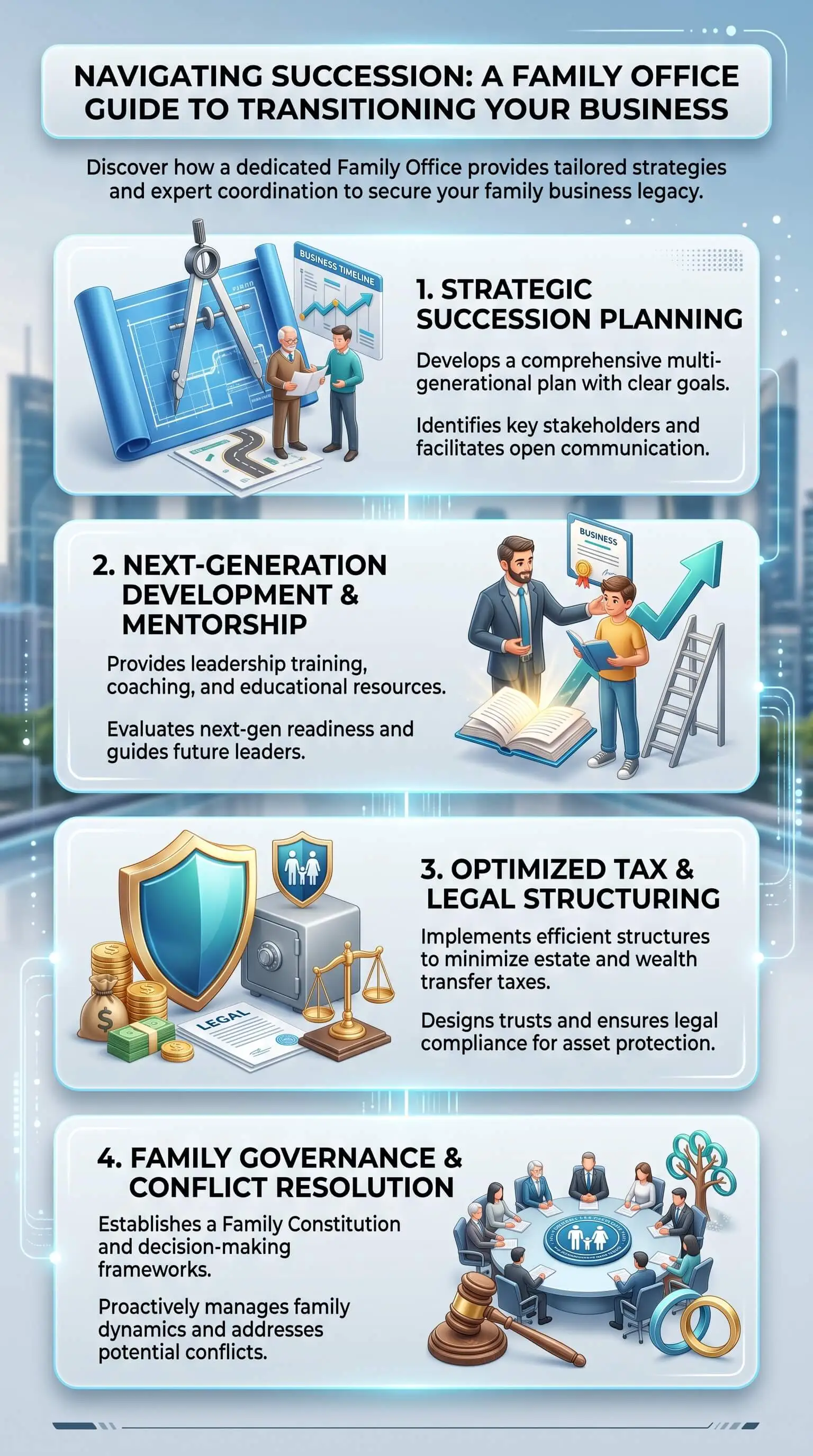
A family office is a private advisory structure that manages a family's whole financial life, from taxes and trusts to investments and governance. In a succession, its job is coordination. It sits between the owner, the family, and every professional involved, and keeps them all working from the same plan.
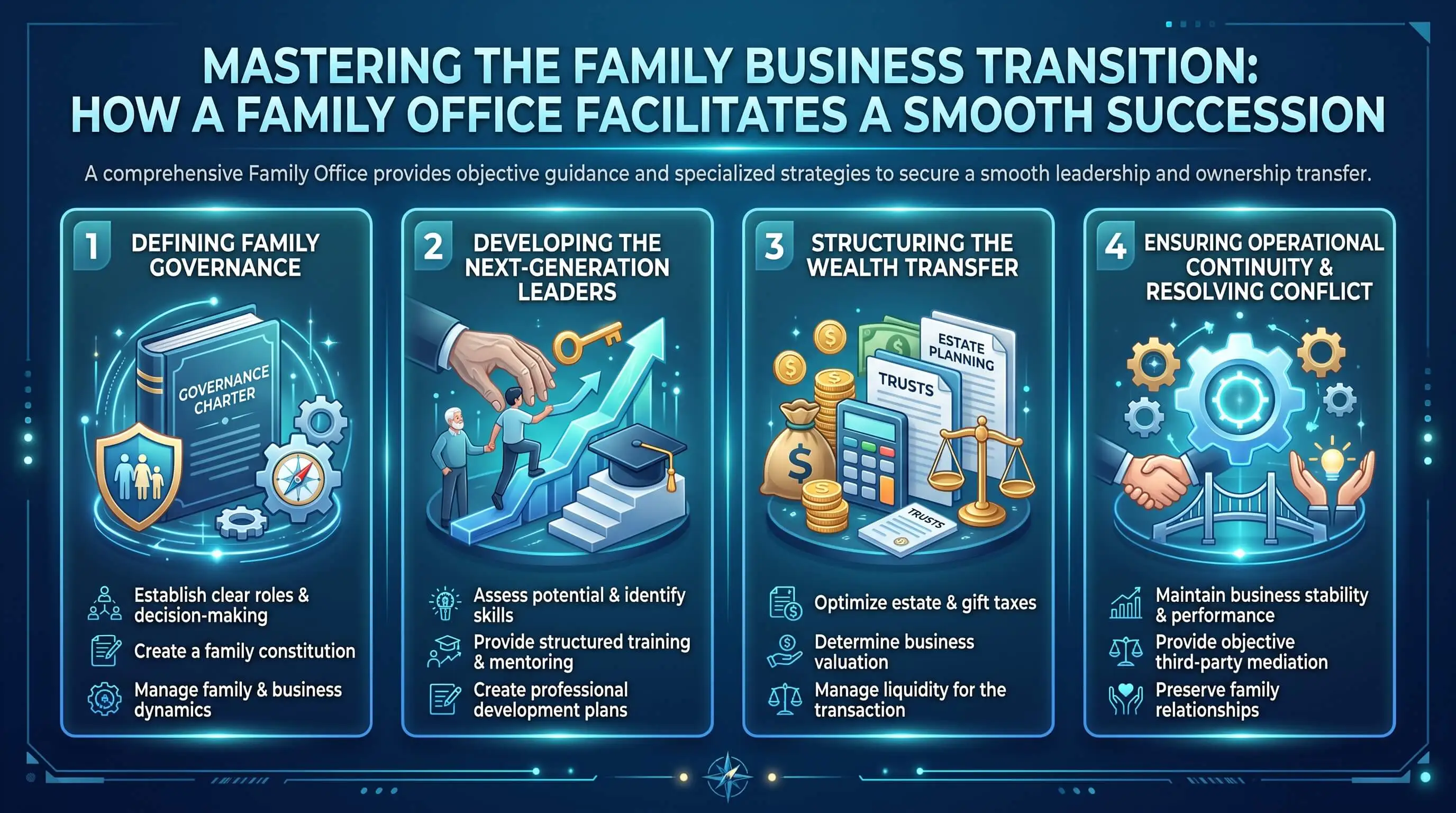
Succession runs on two tracks that rarely move at the same speed. Ownership succession decides who holds the equity. Leadership succession decides who runs the company on Monday morning, and plenty of owners settle one while leaving the other open for years.
Before the Transition: Structure, Trusts, and Tax Modeling
The months before a Letter of Intent or a successor announcement give you more leverage than you'll have at any point after. Once the deal or the leadership change goes public, valuations firm up and the calendar starts making decisions for you.
That window is when attorneys and CPAs may evaluate grantor trusts, spousal lifetime access trusts (SLATs), buy-sell agreements, entity cleanup, and state tax domicile, depending on the facts. Rather than replacing that advice, a family office models after-tax proceeds, tracks who owns each open item, and checks that the estate plan reflects what the business is worth today rather than what it was worth when you signed the documents.
During the Transition: One Quarterback for Every Advisor
A sale or handoff can pull in an M&A attorney, an estate attorney, a CPA, an investment banker, a valuation expert, and a wealth advisor. Each one may be excellent. The trouble starts when the owner ends up playing telephone between them while still running the company.
A Personal CFO function takes that off your plate. It keeps advisors on shared information, documents, decisions, and flags where a tax choice affects the estate plan or a trust structure affects liquidity. Your job is to close the right transaction. Ours is to make sure the family's balance sheet is ready when it closes.
After the Transition: Governance and the Next Generation
The first year after a transition carries the most decision risk. Tax reserves, an investment policy statement, and updated estate documents come first, before anyone starts shopping for the next investment.
Family governance takes longer. Heirs who have never sat in a board meeting can become beneficiaries, trustees, or owners almost overnight, and getting them ready is its own workstream. Many of the families we work with treat education as part of the plan, whether that means choosing the right school for the next generation, setting up trusts that cover grandchildren's tuition, or bringing young adults into family meetings so they can watch how the family actually makes decisions.
We see this across Midwest families, whether the wealth came from a manufacturing company, a professional practice, or generations of Iowa farmland.
"Every owner we've sat across from built something that runs on systems. There's a finance team, a tax plan, a board, a rhythm to how decisions get made. What catches them off guard is that succession hands all of it to the family, and usually faster than they planned. The families who come through it well built their own structure first. They didn't wait for the wire to land to decide who was in charge."
7 Essential Resources
When an owner asks us where to start reading, these are the guides we hand over. None of them is a substitute for advice on your own facts, but together they cover most of the questions that come up in a first meeting.
1. Build a Leadership Succession Roadmap
Egon Zehnder walks through who should be involved in a family business succession and how to set fair eligibility rules for successors. The section on emergency plans is worth reading even if your handoff is years out.
Source: Egon Zehnder, Family Business Succession Planning Best Practices
2. Compare the Four Main Exit Paths
Katten lays out intergenerational succession, minority investment, a sale to insiders, and a full third-party sale side by side. If you haven't decided which road you're on yet, start here.
Source: Katten, Four Strategies for Family Business Succession Planning
3. Prepare Successors Before They Need to Lead
BPM splits succession into immediate, medium-term, and long-term horizons. Its point that leadership development takes years, not months, matches what we see with families who start too late.
Source: BPM, Building Your Legacy: A Practical Guide to Family Office Succession Planning
4. Review the Legal and Financial Framework
J.P. Morgan Private Bank starts with the unglamorous work of estate plans, asset titling, and buy-sell agreements before moving on to developing future leaders. Families with a business plus shared real estate or partnerships will find it especially practical.
Source: J.P. Morgan Private Bank, The Most Important Strategies for Effective Succession Planning
5. Separate Ownership, Management, and Leadership
Creative Planning frames succession as three separate questions about who will own, manage, and lead. That distinction alone clears up a lot of family arguments before they start.
Source: Creative Planning, Best Practices for Business Succession Planning in Family-Owned Enterprises
6. Protect the Family Through the Transfer of Authority
Mercer looks at what goes wrong when authority changes hands badly, and how a shared family story can hold generations together. Read this one if the founder is reluctant to let go.
Source: Mercer, Rethinking Family Office Succession
7. See How Peer Family Businesses Approach Succession
The U.S. Chamber of Commerce pulls together recent PwC and Deloitte findings on succession readiness in a short, plain read. Use it to benchmark where your business stands against its peers.
Source: U.S. Chamber of Commerce CO, How Family Businesses Approach Succession Planning
After reading all seven, our take is that owners can find the technical advice easily, and it's rarely what holds them back. What owners usually lack is one person accountable for moving the legal, tax, and family pieces forward on the same timeline through family office trust and business transition services for business owners.
Supporting Statistics
Owners know succession matters. The surveys show how few of them are ready for it.
1. Succession is already disrupting family businesses
PwC's 2025 US Family Business Survey found that 44% of US family firms said succession planning affected their business in the past year, well above the 34% reported globally.
What it means: For nearly half of US family firms, succession is already shaping this year's decisions.
What we see: Owners often call us after the disruption has begun, when a key leader signals an exit or an unsolicited offer shows up.
Source: PwC, 2025 US Family Business Survey
2. Many owners still have no formal plan
Brown Brothers Harriman surveyed 491 private business owners in 2025 and found only 46% have a formal succession plan in progress, while 30% have none. Just under half (49%) think the next generation is only somewhat prepared to manage wealth.
What it means: Close to a third of owners are one health scare or one offer away from making succession decisions under pressure.
What we see: Owners rarely lack intent. What they lack is someone who owns the job of moving the plan forward while they keep running the company.
3. Plans that exist often stall
Deloitte Private's 2026 survey of 300 family business executives found that 85% call CEO succession planning critical. Yet only 57% have a plan, just 23% are actively carrying one out, and 30% admit they're behind schedule.
What it means: A plan on paper and a plan in motion are two different things, and value leaks in the gap between them.
What we see: Plans stall when the trust documents, the tax modeling, and the leadership decision each sit with a different advisor on a different calendar.
Source: Deloitte Private, Survey Reveals Family Businesses Are Facing a Succession Paradox
Final Thoughts
If we could give owners one piece of advice, it would be to build the family's structure while the business still pays for the time to do it. Waiting until a buyer or successor is named means planning on someone else's calendar.
What the data shows:
Most owners already rank succession as critical, so awareness isn't what's missing.
Where plans break down is execution, usually because the work is split across advisors with no one tracking the whole.
What we've seen at Legacy Bridge:
Good advisors are rarely in short supply. Someone coordinating them usually is.
Owners who run succession like any other operating project, with an owner, deadlines, and regular reporting, get through it with fewer regrets.
The families that fare best talk about the plan early, including with the next generation, long before anyone signs anything.
The business gave the family its structure for decades. Rebuilding that structure around the family is the real work of succession, and it goes best while the owner still has leverage.
This page is educational and is not legal or tax advice. Make trust, tax, and estate decisions with your own attorney and CPA.
Frequently Asked Questions
How can a family office help with business succession planning?
A family office coordinates the tax, trust, estate, and family decisions that surround a change in ownership or leadership. It keeps your attorney and CPA working from one plan and models after-tax outcomes. Once the business no longer provides the family's structure, it helps the family manage wealth and governance on its own.
When should a business owner start succession planning?
Start several years before any transition if you can, and always before you sign a Letter of Intent or announce a successor. That lead time lets attorneys and CPAs evaluate trust structures, entity cleanup, and tax exposure while you still control the timing and terms.
What is the difference between ownership succession and leadership succession?
Ownership succession decides who holds the equity in the business. Leadership succession decides who runs it day to day. The two can land with the same person or with different people, and each needs its own documents and timeline.
Does a family office replace my CPA or estate attorney?
No. A family office works alongside your existing professionals, and legal and tax advice still comes from your licensed attorneys and CPAs. Its role is to keep them aligned, track decisions, and make sure the plan actually gets carried out.
What trusts are commonly used in business succession planning?
Depending on the facts, attorneys may evaluate grantor trusts, spousal lifetime access trusts (SLATs), and charitable vehicles, often paired with a buy-sell agreement. The right structure depends on your goals, your family, and your tax exposure, so choose it with qualified legal counsel.
How much wealth do you need to work with a family office?
Complexity matters more than a fixed number. Legacy Bridge works with families managing $10 million or more, and many owners first consider family-office-level support around a business sale, a recapitalization, or a leadership transition.
Start Your Succession Plan Before the Deadline Sets It for You
The best time to build your family's structure is while you still control the timeline. If a sale, recapitalization, or leadership handoff is on the horizon, see how Legacy Bridge works with business owners before and after a transition and schedule a private consultation before you lock in the key trust, tax, and ownership decisions.
Succession planning and education planning overlap more than most families expect, since both come down to preparing the next generation for decisions that will shape their lives. Parents weighing what private school tuition really costs or how private school paths lead to top universities are often the same people setting up trusts and governance plans to support those choices for decades.