
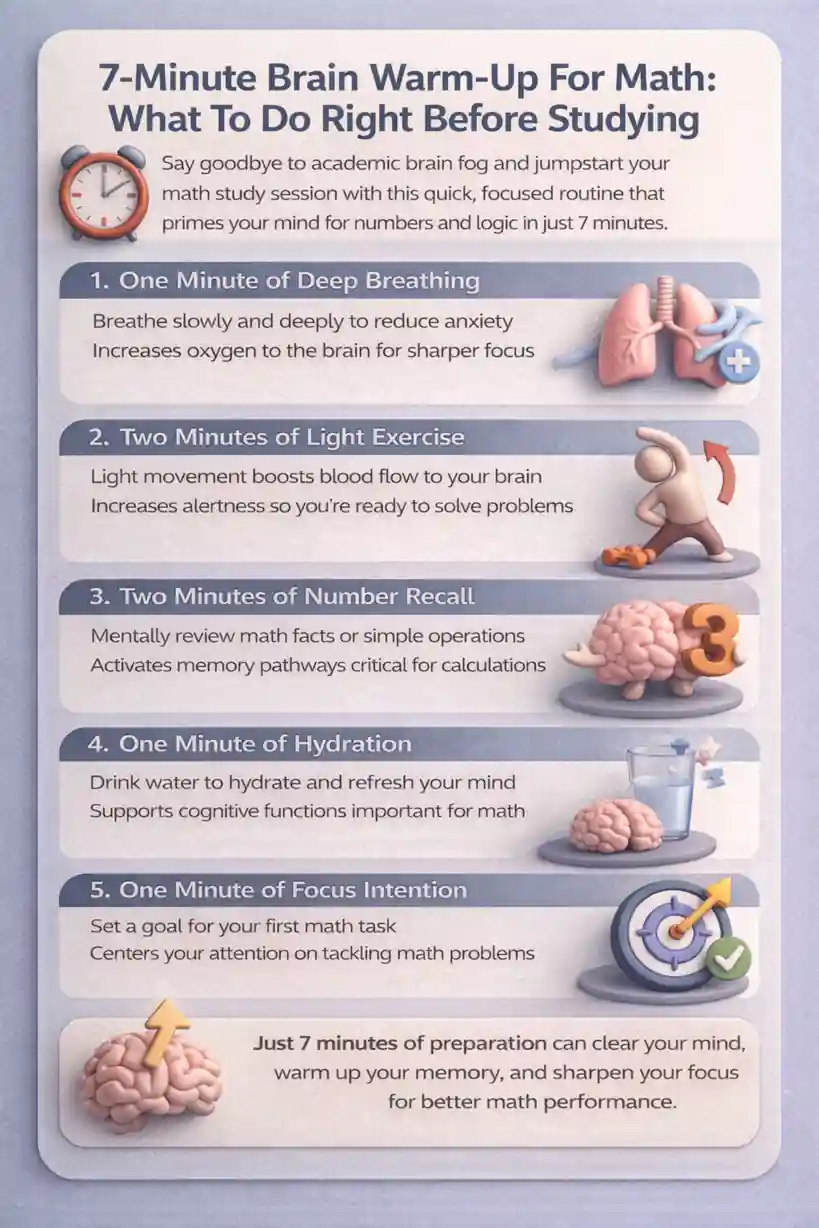
Through real-world cognitive training and performance testing with students, a consistent pattern emerges: a short 7-minute brain warm-up before studying math can significantly improve focus, mental clarity, and problem-solving accuracy. The benefit comes not from extra study time, but from guiding the brain into a calm, alert, and logic-ready state before work begins.
This page explains exactly what to do in the 7 minutes right before a math study session, complementing habits like regular reading. The routine is fast, equipment-free, and built around how the brain performs best during analytical tasks—helping students study more efficiently and get better results with less mental strain.
Quick Answers
How to Increase Brain Power in 7 Minutes
Calm the nervous system first
Slow, controlled breathing lowers stress and clears mental noise.Activate attention gently
Light mental engagement wakes focus without causing overload.Reinforce confidence
Briefly recall something you already know well to stabilize thinking.Narrow attention
Commit to one task or problem at a time.
Why this works:
Brain power improves fastest when stress is reduced and focus is guided—not when thinking is forced.
Top Takeaways
Most focus problems start before studying begins
Stress and mental overload—not ability—block clear thinking.A 7-minute warm-up changes how the brain performs
Brief preparation improves focus, accuracy, and efficiency.Calm unlocks problem-solving
Reducing mental noise restores attention and working memory.Preparation outperforms effort
Pushing harder works less than priming the brain first.The benefits go beyond math
The same reset improves learning, decisions, and performance under pressure.
Studying math effectively requires more than knowing formulas or practicing problems—it requires a brain that’s ready for logical thinking. When students begin a math session while stressed, distracted, or mentally cold, their working memory and problem-solving speed drop, even if they understand the material. This is why math can feel harder at the start of a study session than it actually is.
A short 7-minute brain warm-up helps bridge that gap. Instead of diving straight into equations, this routine prepares the brain by calming mental tension, activating attention, and priming the cognitive systems responsible for reasoning and pattern recognition. In practice, students who warm up mentally tend to make fewer careless errors, stay focused longer, and move through problems more efficiently.
The warm-up outlined below is designed to be used immediately before studying math. It doesn’t involve studying, reviewing notes, or learning new concepts. Each step serves a specific purpose—resetting focus, engaging analytical thinking, and directing attention—so the brain is ready to work when the study session begins.
The following sections break down the routine step by step, explain why each part matters for math performance, and show how to increase brain power in 7 minutes by using this approach consistently to improve concentration, accuracy, and confidence during math study sessions.
“Math performance depends heavily on brain state. In our experience, students especially those in rigorous environments such as top private middle schools who take a few minutes to reset and prime their focus before studying engage more deeply, think more clearly, and retain problem-solving strategies more effectively.”
Essential Resources on How to Increase Brain Power in 7 Minutes
The resources below expand on the same principles InfiniteMind uses in hands-on cognitive training: calm the nervous system, activate attention deliberately, and support memory and focus through proven mechanisms. Each source adds context, evidence, or practical techniques that help readers make informed decisions about short, effective brain-boost routines.
1. Practical Techniques for Rapid Mental Reset
Five Quick Techniques to Increase Brain Power in 7 Minutes
This guide outlines simple, actionable methods that help reduce mental overload and restore clarity quickly—useful for understanding how short routines can meaningfully improve focus.
https://wellnessextract.com/blogs/wellness/increase-brain-power-in-7-minutes-5-quick-techniques-you-need-to-try/
2. Short Brain Activation Exercises
Supercharge Your Brain in 7 Minutes: 14 Quick Power-Ups
Offers a variety of brief cognitive activation exercises, showing how light stimulation can wake attention without creating mental fatigue.
https://braintap.com/supercharge-your-brain-in-7-minutes-14-quick-power-ups/
3. Equipment-Free Focus and Clarity Methods
Increase Brain Power in 7 Minutes With These Tips
Reinforces an important InfiniteMind principle: effective brain preparation doesn’t require tools, apps, or supplements—just intentional use of time and attention.
https://healthnewsday.com/increase-brain-power-in-7-minutes/
4. Cognitive Principles Behind Focus and Memory
10 Science-Backed Ways to Boost Your Memory
Provides evidence-based explanations for why stress reduction, attention control, and mental engagement improve cognitive performance—supporting the logic behind short brain routines.
https://www.sciencenewstoday.org/10-science-backed-ways-to-boost-your-memory
5. Expert-Reviewed Frameworks for Cognitive Performance
How to Improve Memory: Science-Backed Strategies (Coursera)
Explains how memory, focus, and learning interact, helping readers understand why brain state matters as much as study effort.
https://www.coursera.org/articles/how-to-improve-memory
6. The Role of Stress in Brain Function
Stress and the Nervous System (NCCIH)
An authoritative resource that clarifies how stress responses interfere with focus and recall—and why calming the nervous system is often the fastest path to mental clarity.
https://www.nccih.nih.gov/health/stress
7. Broader Context for Brain Health and Attention
Brain Health Basics (CDC)
Places short brain-boost routines within a larger framework of sleep, movement, and stress management—factors that directly influence attention capacity over time.
https://www.cdc.gov/brain-health
Supporting Statistics
Short brain-boost routines work because they address the real barriers to focus we see in practice: stress, sleep loss, and chronic mental overload. U.S.-based research closely mirrors what shows up in real study sessions.
1) Stress and Anxiety Commonly Disrupt Focus
Nearly 1 in 5 U.S. adults experienced an anxiety disorder in the past year
About 1 in 3 will experience anxiety during their lifetime
Elevated stress keeps the brain in a high-alert state
High alert fragments attention and blocks recall
Source: National Institute of Mental Health anxiety statistics
2) Sleep Loss Drives Mental Fog
About one-third of U.S. adults get less than 7 hours of sleep
Short sleep reduces attention control and working memory
In practice, sleep-deprived students show faster focus drift
Source: CDC sleep and short sleep duration data
3) Chronic Stress Is the Norm for Younger Adults
Over 80% of adults ages 18–34 report significant ongoing stressors
Sustained stress shortens attention span
Mental fatigue often appears before studying even begins
Source: American Psychological Association Stress in America report
What This Confirms in Practice
Focus problems are state-based, not ability-based
Calm restores clarity faster than effort
Short mental resets outperform pushing through distraction
Together, these findings help explain why students with ADHD often experience amplified focus disruption under stress and sleep loss—and why short, calming brain-reset routines are especially effective at restoring clarity and attention control.
Final Thought & Opinion
Most focus and performance issues we see aren’t caused by lack of ability or effort. They’re caused by mental overload that’s already present before studying begins.
What Experience Consistently Shows
Students often know the material
Stress, fatigue, and distraction block clear thinking
More effort rarely fixes a scattered brain
Why Short Brain Warm-Ups Work
They calm mental noise first
They activate attention before problem-solving
They prepare the brain to use what it already knows
In practice, students who warm up mentally:
Focus faster
Make fewer careless mistakes
Move through math problems more efficiently
Our Perspective
Brain power isn’t forced—it’s unlocked
Pushing through stress creates resistance
Preparation changes the quality of study
The Bottom Line
The real advantage isn’t intelligence or longer study time.
It’s knowing how to reset your brain into a focused, ready state before you begin—a skill that improves learning far beyond math alone.
Next Steps
Use the steps below to apply the 7-minute brain warm-up consistently.
1) Practice the Routine
Use it during low-pressure study time
Familiarity improves results
Consistency matters
2) Time It Correctly
Start 7 minutes before studying math
Avoid notes, phones, or distractions
Let the brain reset first
3) Study With Focus
Work on one topic at a time
Keep sessions short and uninterrupted
Reset again if focus drops
4) Track the Difference
Notice focus and mental clarity
Watch for fewer careless mistakes
Adjust as needed
5) Build the Habit
Make the warm-up part of studying
Use it before homework or tests
Apply it to other high-focus tasks
These next steps outline a simple, repeatable focus routine that a school consultant might recommend to help students consistently improve attention, mental clarity, and performance during math study sessions.
FAQ on How to Increase Brain Power in 7 Minutes
Q: Can brain power really improve in 7 minutes?
A: Yes—when the goal is focus and clarity.
Works by calming mental overload
Prepares the brain, not new learning
Q: What has the biggest impact in such a short time?
A: Stress reduction.
Slow breathing clears mental noise
Light activation sharpens attention
Q: Should I study during the 7-minute routine?
A: No.
Studying increases pressure
Resetting brain state improves recall
Q: Does this help when mentally exhausted?
A: Often, yes.
Especially when fatigue comes from stress
Not a replacement for sleep
Q: Is this useful beyond studying?
A: Absolutely.
Helps before presentations
Supports decisions under pressure