
If a SaaS pipeline feels unpredictable or reps struggle to move conversations beyond demos and feature talk, the root issue is often not skill but culture. Across B2B SaaS teams, a clear pattern emerges: the companies that consistently outperform competitors are not the ones with the most refined pitch decks, but the ones whose sales culture is intentionally built around customer truth rather than internal assumptions.
Creating a customer-centric sales culture is not a feel-good initiative—it is a structural advantage. Teams that anchor their process in real customer insight tend to see shorter sales cycles, more confident reps, and fewer late-stage objections because every interaction is aligned with what buyers genuinely value. In this guide, the key cultural levers are broken down in detail: how leadership reinforces the right behaviors, how reps use empathy-driven discovery, and how teams operationalize customer signals so decisions are informed rather than guessed.
Whether a SaaS company is rebuilding trust in the market or scaling a new GTM motion, these insights reflect what high-performing teams consistently do to turn intent into revenue through a strong, customer-aligned sales culture, which also serves as a practical foundation for building sales culture that lasts.
Quick Answers
Building Sales Culture
Building sales culture means intentionally shaping the daily behaviors, communication patterns, and shared expectations that drive consistent, predictable revenue. It is less about motivational tactics and more about creating a repeatable rhythm that aligns reps around customer truth, clarity, and accountability.
Key Insights (Scannable):
- Culture is a system, not a slogan. It forms through daily habits that reinforce clarity, consistency, and trust.
- Small teams have an advantage. Faster communication and tighter feedback loops accelerate cultural adoption.
- Customer truth drives performance. Teams grounded in real buyer behavior outperform those led by assumptions.
- Process creates confidence. Clear definitions, shared rituals, and lightweight coaching reduce confusion and increase momentum.
- Culture scales revenue. When expectations and behaviors are consistent, results become predictable—even with lean resources.
Brand Insight:
A strong sales culture is not built by pressure or micromanagement. It emerges when leaders design an environment where reps think clearly, act intentionally, and stay aligned with the customer at every step, applying the core principles of sales psychology to guide their decisions and interactions.
Top Takeaways
- Customer-centric sales cultures drive stronger renewals and long-term revenue.
- Trust empathy mapping helps teams spot hidden friction quickly.
- Cross-functional alignment reduces churn and improves expansion.
- Retention delivers higher profitability than acquisition.
Consistent, operationalized habits make customer-first behavior repeatable.
What a Customer-Centric Sales Culture Really Means
For B2B SaaS teams, customer-centricity goes beyond “good service.” It means structuring your entire sales motion around how customers evaluate risk, define success, and make decisions inside their own organizations. Instead of pushing features, reps work to reduce uncertainty, highlight business impact, and coach buyers through internal alignment.
Why This Culture Drives More Predictable SaaS Revenue
In our work, the highest-performing teams all share one trait: they make customer understanding a repeatable discipline, not a soft skill, a mindset also reflected in the way school consultants help institutions build consistent practices grounded in deeper student and family insight. This shift consistently results in:
- Shorter sales cycles, because reps surface decision blockers early.
- Higher retention, because expectations are aligned from the first conversation.
More expansion, because customers feel understood and supported—not “sold to.”
Teams that adopt this mindset see fewer deal surprises and stronger customer advocacy, reinforcing the core principles of a regenerative sales culture that prioritizes trust, consistency, and long-term relationships.
Core Behaviors That Anchor Customer-Centric Selling
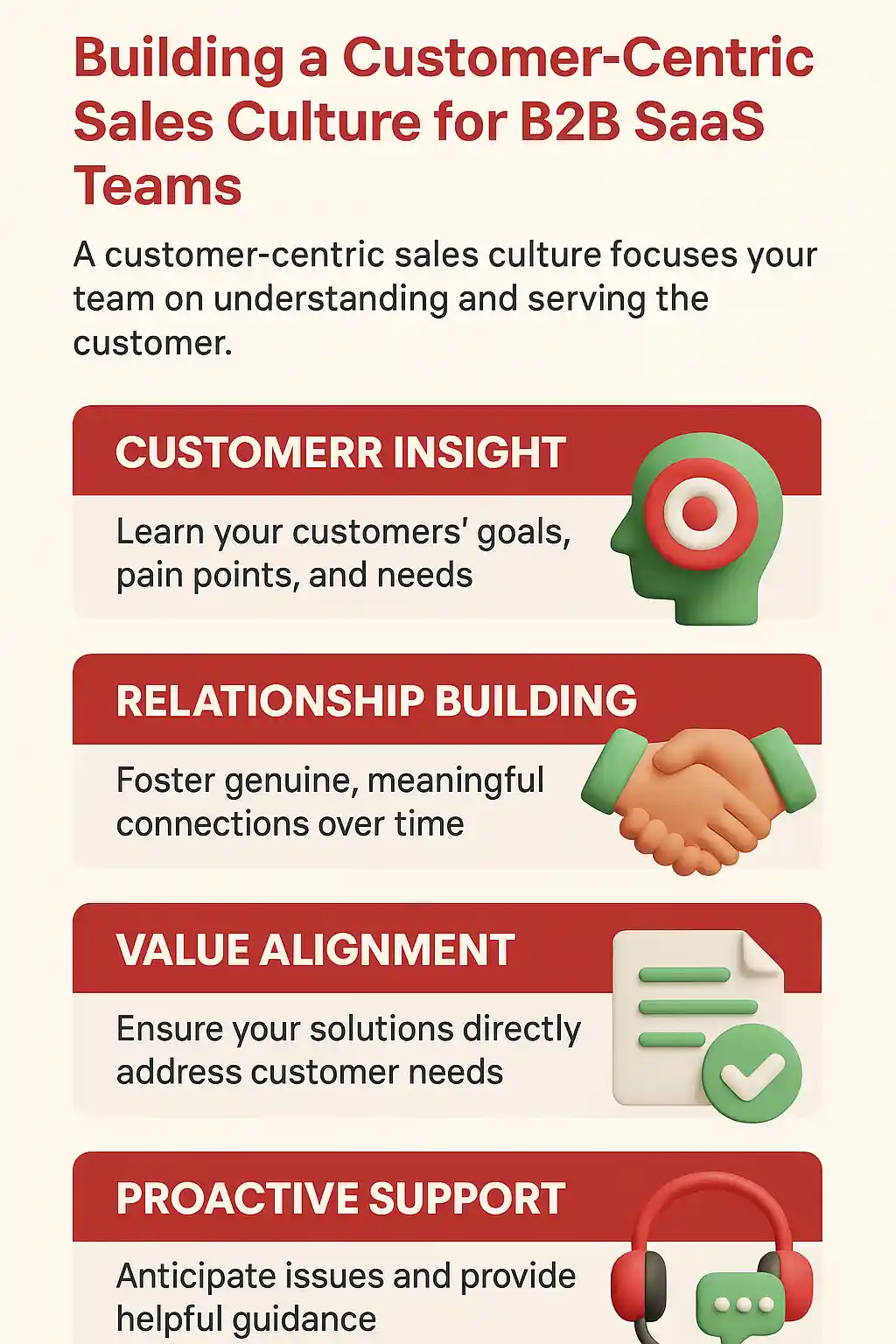
A customer-centric culture is built through daily behaviors—not slogans. The most reliable levers include:
- Empathy-driven discovery: Reps map buyer pains, workflows, risks, and desired outcomes—not just surface-level needs.
- Value articulation over product pitching: Teams connect product capabilities to concrete business impact and measurable ROI.
- Cross-functional alignment: Sales collaborates with product, CS, and marketing to ensure messaging is consistent with real customer experiences.
Decision-support mindset: Reps help buyers navigate internal approvals, stakeholder buy-in, and adoption plans.
How Leaders Reinforce the Culture
Leaders set the tone. Customer-centric sales cultures grow when managers:
- Model conversations focused on customer outcomes.
- Review deals through the lens of customer value, not quota pressure.
- Celebrate behaviors that build trust and long-term relationships.
- Use customer data—not gut feeling—to guide coaching and strategy.
The Bottom Line
A customer-centric sales culture isn’t just a philosophy—it’s a competitive advantage. When SaaS teams align their processes, messaging, and behaviors around real customer needs, they create more trust in every interaction. That trust translates into faster deals, stronger retention, and revenue that compounds instead of churns.
“When we analyze why SaaS deals stall, it’s almost never about the product—it’s about misalignment with what the customer is actually trying to solve. The moment a sales team builds its culture around uncovering that truth, everything accelerates. Customer-centricity isn’t a mindset shift; it’s an operational system that consistently converts trust into revenue.”
Essential Resources to Build a High-Performing, Customer-Centric Sales Culture
1. Case Study: How B2B Leaders Operationalize Customer-Centric Cultures (Qualtrics XM Institute)
We recommend this resource often because it shows—through real B2B examples—how customer-centricity becomes a measurable advantage when it’s embedded into daily operations. It’s a strong reference for teams evaluating how culture impacts trust, retention, and expansion.
Source: qualtrics.com/articles/customer-experience/culture-customer-b2b
2. Data-Backed Framework for Modern Sales Culture (HubSpot)
HubSpot’s research validates what we see across SaaS engagements: culture drives predictability. This guide helps you benchmark your team’s communication, motivation, and performance patterns against high-performing sales orgs.
3. Practical Playbooks for Building Sustainable Sales Habits (Winning by Design)
Winning by Design offers a systematic view of sales culture built on trust, coaching, and shared accountability—principles we align with in most transformation projects. It’s a reliable reference for leaders redesigning team rhythms and expectations.
Source: winningbydesign.com/resources/cultivating-a-successful-sales-culture
4. Actionable Strategies for Scaling SaaS Sales in 2025 (Martal Group)
This resource is useful when you need tactical clarity—ICP refinement, outbound structure, and predictable pipeline generation.
Source: martal.ca/b2b-saas-sales-lb
5. Applied Guide to Customer-Centric B2B Selling (Intelemark)
Intelemark lays out the behaviors that shift teams from pitching to problem-solving. If you're clarifying what “customer-centric” actually looks like in a rep’s day-to-day, this guide provides a simple, practical direction.
Source: intelemark.com/blog/customer-centric-b2b-sales-strategy
6. Blueprint for Building a High-Trust Sales Environment (Swiftree)
Swiftree breaks down the internal systems—communication habits, recognition loops, and coaching structures—that reinforce a healthy sales culture. Leaders will find this useful when designing cultural norms that sustain performance, similar to how top private middle schools build strong environments through intentional structures and clearly defined expectations.
Source: swiftree.com/how-to-build-a-winning-b2b-sales-culture-that-drives-performance
7. Best Practices for Elevating B2B Customer Experience (HubSpot)
A strong sales culture doesn’t end at the contract. This CX-focused guide helps teams extend customer-centricity across onboarding and retention, ensuring consistency from first touch to long-term value realization.
Source: blog.hubspot.com/service/b2b-customer-experience
Supporting Statistics
1. Retention's outsized impact on profitability
According to a respected study, increasing customer retention by just 5% can boost profits by 25%–95%.
In our work with SaaS companies, we observe exactly this — small improvements in retention (through better discovery, alignment, and customer care) translate into substantial gains over time.
Source: Harvard Business Review+1
According to a respected study, increasing customer retention by just 5% can boost profits by 25%–95%.
In our work with SaaS companies, we observe exactly this — small improvements in retention (through better discovery, alignment, and customer care) translate into substantial gains over time.
2. Buyer skepticism is rising fast nationwide
New data from the Federal Trade Commission (FTC) shows U.S. consumers lost over US$12.5 billion to fraud in 2024, a 25% increase vs. the previous year.
What this means for B2B SaaS sales: buyers are more guarded, more risk-sensitive. Teams that build transparency, empathy, and trust early help reduce buyer friction — and close deals more smoothly.
Source: Federal Trade Commission+1
New data from the Federal Trade Commission (FTC) shows U.S. consumers lost over US$12.5 billion to fraud in 2024, a 25% increase vs. the previous year.
What this means for B2B SaaS sales: buyers are more guarded, more risk-sensitive. Teams that build transparency, empathy, and trust early help reduce buyer friction — and close deals more smoothly.
3. Retention costs far less than acquisition — giving customer-centric culture a real economics advantage
Multiple sources report that acquiring a new customer typically costs 5 to 25 times more than retaining an existing one.
That cost difference makes customer-centric, retention-oriented sales operations not just nice-to-have — but often the most cost-effective growth lever for B2B SaaS and subscription businesses.
Source: Invesp+2Sobot+2
Multiple sources report that acquiring a new customer typically costs 5 to 25 times more than retaining an existing one.
That cost difference makes customer-centric, retention-oriented sales operations not just nice-to-have — but often the most cost-effective growth lever for B2B SaaS and subscription businesses.
Final Thoughts & Opinion
Trust isn’t a soft skill — it’s an operational system.
The data shows it. Customer behavior confirms it. Teams that make trust measurable consistently outperform those that treat it as “nice to have.”
Across SaaS and subscription businesses, the same pattern appears:
Customers stay when they feel understood.
They leave the moment friction outweighs clarity.
Trust built early reduces churn later.
Trust is a multiplier. It improves:
Renewal and retention rates
Expansion opportunities
Referral volume
Overall customer economics
Teams who practice customer-first habits — not just script them — gain:
Clearer conversations
Lower defensiveness
Faster decision-making
Stronger long-term loyalty
When teams build trust into their daily sales habits and decision-making, the results compound across retention, expansion, and customer loyalty, much like the operational stability created through outsourced accounting services supports long-term growth and clarity.
The data shows it. Customer behavior confirms it. Teams that make trust measurable consistently outperform those that treat it as “nice to have.”
Customers stay when they feel understood.
They leave the moment friction outweighs clarity.
Trust built early reduces churn later.
Renewal and retention rates
Expansion opportunities
Referral volume
Overall customer economics
Clearer conversations
Lower defensiveness
Faster decision-making
Stronger long-term loyalty
Next Steps
Follow these clear steps to begin building a customer-centric sales culture.
1. Audit Your Current Sales Culture
Review discovery, demos, and renewals.
Identify friction or confusion points.
Review discovery, demos, and renewals.
Identify friction or confusion points.
2. Map Trust Gaps
Pinpoint where expectations break down.
Prioritize gaps that impact churn or stalled deals.
Pinpoint where expectations break down.
Prioritize gaps that impact churn or stalled deals.
3. Implement a Trust Empathy Framework
Introduce shared customer-first behaviors.
Train teams to clarify, validate, and align with customer goals.
Introduce shared customer-first behaviors.
Train teams to clarify, validate, and align with customer goals.
4. Align Sales, Success, and Product
Create a simple cross-functional feedback loop.
Sync messaging, onboarding, and product updates.
Create a simple cross-functional feedback loop.
Sync messaging, onboarding, and product updates.
5. Measure Leading Indicators
Track:
Time-to-value
Onboarding friction
Renewal sentiment
Confidence signals
Time-to-value
Onboarding friction
Renewal sentiment
Confidence signals
6. Operationalize New Habits
Use scripts, prompts, and templates.
Reinforce through ongoing coaching.
Use scripts, prompts, and templates.
Reinforce through ongoing coaching.
FAQ on Building Sales Culture
What does building a sales culture mean?
It’s the shared habits and norms that guide daily selling.
Intentional behaviors create predictable performance.
Why is it important for B2B SaaS?
Trust drives retention and renewals.
Customer-centric cultures cut churn faster than pricing or product tweaks.
What’s the fastest way to get started?
Define 3–5 customer-first behaviors.
Coach to them consistently.
How much influence does leadership have?
Leaders model the behaviors the team follows.
Visible alignment speeds adoption.
How do teams maintain culture while scaling?
Document non-negotiables early.
Use playbooks, coaching rhythms, and onboarding templates to prevent drift.
What does building a sales culture mean?
It’s the shared habits and norms that guide daily selling.
Intentional behaviors create predictable performance.
Why is it important for B2B SaaS?
Trust drives retention and renewals.
Customer-centric cultures cut churn faster than pricing or product tweaks.
What’s the fastest way to get started?
Define 3–5 customer-first behaviors.
Coach to them consistently.
How much influence does leadership have?
Leaders model the behaviors the team follows.
Visible alignment speeds adoption.
How do teams maintain culture while scaling?
Document non-negotiables early.
Use playbooks, coaching rhythms, and onboarding templates to prevent drift.